Bagaceira
workshop
From fiber to form: local plant residues as materials for making
This workshop explores plant fibres as a local material resource at a time when design, building, and manufacturing remain heavily dependent on synthetic materials. Many regions produce fibrous residues through agriculture, forestry, and industry, yet these materials are often discarded, burned, or directed into low-value uses.
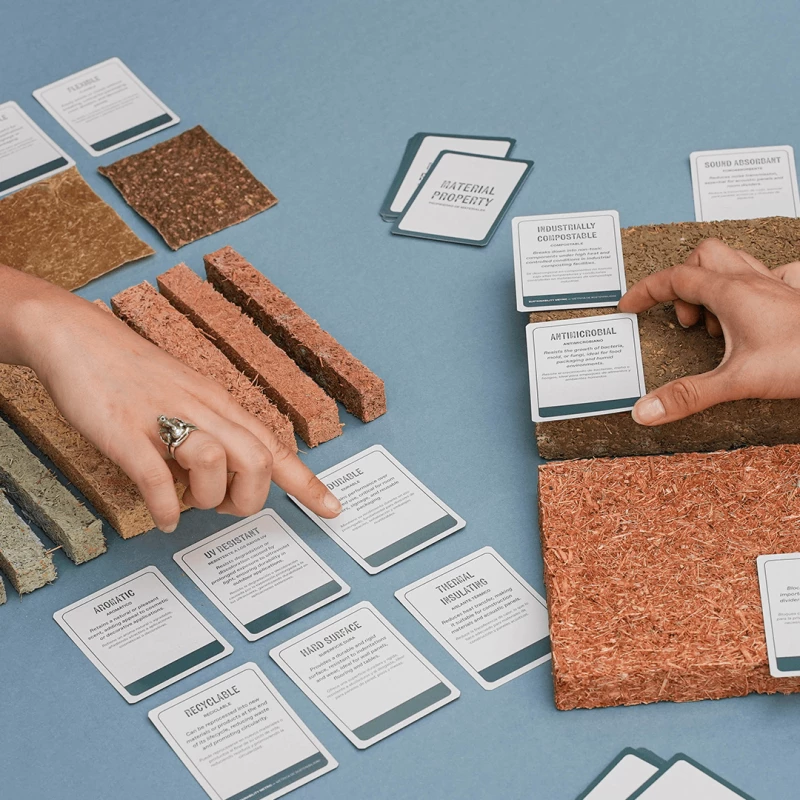
The workshop invites participants to look at these fibres differently: not only as residues, but as materials with ecological and cultural relevance, distinct textures, structural qualities, and potential for transformation. Participants will examine fibres and by-products from the region, such as corn husks, cork waste, rice husk, or brewers’ spent grain, and compare them in terms of origin, availability, composition, texture, and behaviour.
The session also unpacks some of the reasons for working with plant fibres today. These materials emerge from seasonal and agricultural cycles, store carbon as they grow, are often regionally abundant, and can strengthen composite materials. When combined with suitable bio-based binders, they can support more biodegradable and lower-impact material systems.
In the practical part of the workshop, participants will use bio-based binders to make small moulded objects, each taking home a piece made during the session. Combining observation, discussion, and hands-on testing, the workshop offers an accessible introduction to bio-based material design guided by the qualities and possibilities of local fibres.
No previous knowledge required. All materials and tools are provided. Participants can bring a locally sourced fibre to experiment with. Participants should wear comfortable clothing appropriate for manual activities.
TUTORS
DATE
DURATION
TICKET PRICE
VENUE
exhibition
MIRA Table Lamp and Pendant Lamp
The MIRA Table Lamp and Pendant Lamp are handcrafted from sugarcane bagasse, a fibrous agricultural byproduct that is often discarded after sugar and rum production. This collection transforms that abundant waste material into elegant lighting pieces that bring warmth, texture, and character to interior spaces. Each lamp is made from Bagaceira’s Fiber Board, a material composed of bagasse and biodegradable plant- and mineral-based binders, resulting in a material that is both expressive and non-toxic. Natural clay and mineral pigments lend the lamps their earthy tones, reinforcing a close connection between material, color, and landscape. The collection reflects Bagaceira’s commitment to circular design by treating waste not as an endpoint, but as a starting point for beauty, function, and innovation. Through simple yet tactile forms, the MIRA Lamps invite viewers to reconsider the possibilities of bio-based materials in contemporary interiors and to imagine more responsible relationships between design, industry, and the resources that surround us in abundance but are often overlooked.
DESIGNER
DATE
VENUE
About the project
Bagaceira is a research and design studio founded by designer, Julia Steketee and bioeconomy researcher, Igor Barboza. The studio explores how sugarcane bagasse and other plant fibres can be transformed into bio-based materials, interior objects, and workshop-based learning experiences grounded in circular and regenerative design.

Contact us
Gentler Futures Festival is a not-for-profit initiative by BY THE END OF MAY, a research and design studio exploring the roles of manufacturing and crafts in creating a (non-linear), (post-consumerism) and (anti-alienation) economy. If you are into open source design, distributed manufacturing, local making and regenerative materials, get in touch with us.
A project

Co-funded by
Official Partner

Institutional Partners

Academic Partner

International Partners
