COMPO (MOME)
exhibition
Colours of Invasive Pigments
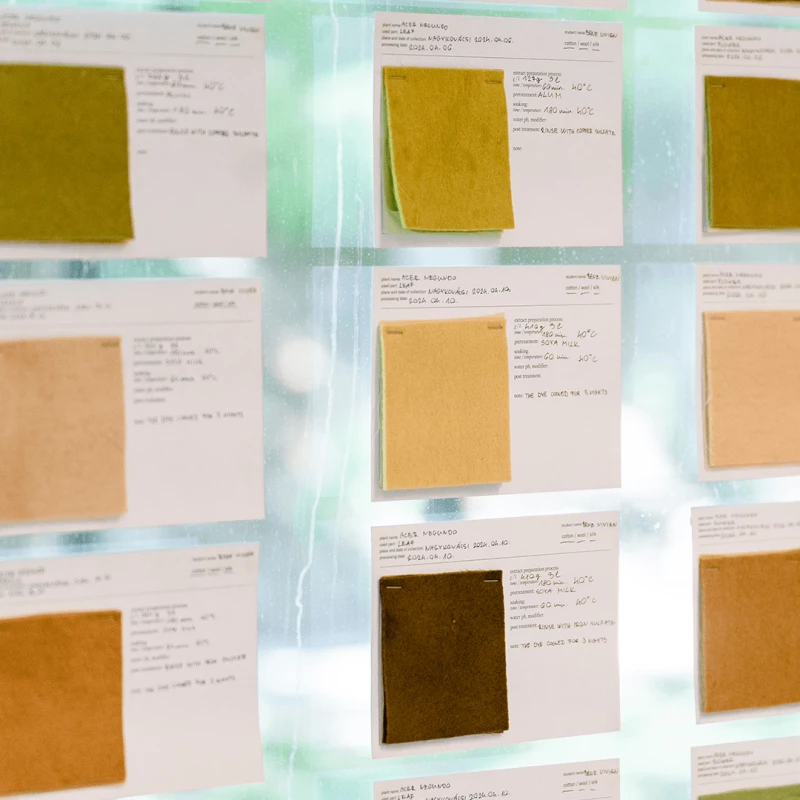
Invasive plant species are among the fastest spreading and most difficult-to-control elements of many ecosystems, often outcompeting native vegetation and generating large amounts of unmanaged biomass. Rather than approaching these plants solely as ecological waste, the COMPO project explored their potential as locally available regenerative resources for natural textile coloration and material experimentation.
Focusing on Goldenrod (Solidago) and Japanese Knotweed (Fallopia), students extracted pigments from harvested plants and investigated how invasive species could contribute to a broader vision of a more ecological and chemical-free textile industry.
Through hands-on experimentation, the course combined traditional plant dyeing techniques with contemporary material research methodologies. Students explored fermentation, water pH modification, and milk-based mordants while testing how environmental conditions such as sunlight, darkness, and semi-shadow influence color behavior and pigment transformation. By combining traditional knowledge with open-source and DIY approaches, the project encouraged new ways of thinking about material cycles, waste, and regenerative design practices.
DESIGNERS
DATES
VENUE
About the project
COMPO is a course at Moholy-Nagy University of Art and Design (MOME), Budapest, exploring material experimentation through ecological design. It works with industrial by-products, plant-based waste, and underused natural resources, combining traditional techniques, open-source methods, and hands-on prototyping to investigate alternative material approaches.


Contact us
Gentler Futures Festival is a not-for-profit initiative by BY THE END OF MAY, a research and design studio exploring the roles of manufacturing and crafts in creating a (non-linear), (post-consumerism) and (anti-alienation) economy. If you are into open source design, distributed manufacturing, local making and regenerative materials, get in touch with us.
A project

Co-funded by
Official Partner

Institutional Partners


Academic Partner

International Partners
