Fahrenheit.works
installation
A flor do azulejo, a cor do Tejo / From the Tejo to the tile
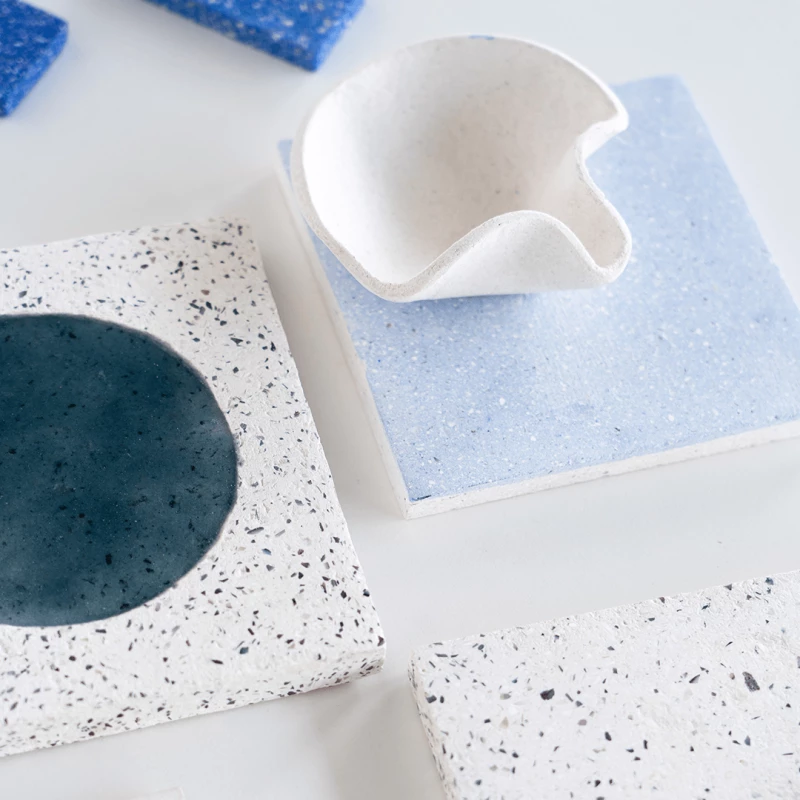
A flor do azulejo, a cor do Tejo reimagines the Portuguese tile (azulejo) through fully biodegradable materials drawn from a single ecosystem: the Tagus estuary. Oyster shells and algae sourced from local waters and food supply chains are recomposed into tiles, then assembled into three pieces in JAM Lisbon's patio.
The first is a bench surfaced with natural white oyster tiles. The second is a sink built around a closed water system integrated with planting. The third is a counter top table covered with marbled blue tiles whose patterns recall aerial views of the estuary's shifting channels. Each piece rests on irregular metal legs, slightly unstable, closer to creatures than to furniture: they sit like dreamers or accidental wanderers that evoke unpredictable movements.
This work also recalls the forgotten oyster farming culture that once flourished in the Tagus before industrialisation. In this context, the oyster is approached as a more-than-human collaborator: a natural filter cleaning 200 litres of water per day, a stabilizer of coastlines, and a keeper of memory. Blending ecological storytelling and spatial exploration, the installation offers a vision for regenerative urban futures grounded in local resources and crafted traditions.
DESIGNERS
DATES
VENUE
exhibition
A flor do azulejo, a cor do Tejo / From the Tejo to the tile
The work presented is part of an ongoing material research project led by the collective Fahrenheit.works, previously part of the Radical Waters – Concrete Matters 2024–2025 residency (Bauhaus of the Sea Sails and the Gulbenkian Foundation). The project focuses on creating tiles formulated exclusively from biomaterials: oyster shells and algae sourced from the Tagus estuary and local food supply chains. These pieces offer a contemporary reinterpretation of Lisbon's iconic azulejo, a centuries-old vehicle of Portuguese identity.
Beyond their circular and biodegradable composition, the tiles reactivate the memory of a once-thriving aquaculture heritage that was erased by industrialisation in the 1970s. The banks of the Tagus once harbored the most prolific natural oyster beds in Europe. By revisiting this legacy, the project highlights the ecological role of the oyster as a natural water filter and as a living system that supports biodiversity and stabilizes coastlines.
Combining material research with ecological reflection, A flor do azulejo, a cor do Tejo explores how local biological resources can inform architectural materials beyond conventional extractive practices.
DESIGNERS
DATES
VENUE
About the studio
Fahrenheit.works is a design practice working with bio-based materials. The work combines traditional knowledge and experimental research to question dominant building approaches and material choices, focusing on how design can support ecological systems and respond to social contexts through locally grounded practices.


Contact us
Gentler Futures Festival is a not-for-profit initiative by BY THE END OF MAY, a research and design studio exploring the roles of manufacturing and crafts in creating a (non-linear), (post-consumerism) and (anti-alienation) economy. If you are into open source design, distributed manufacturing, local making and regenerative materials, get in touch with us.
A project

Co-funded by

Official Partner

Institutional Partners


Academic Partner

International Partners
