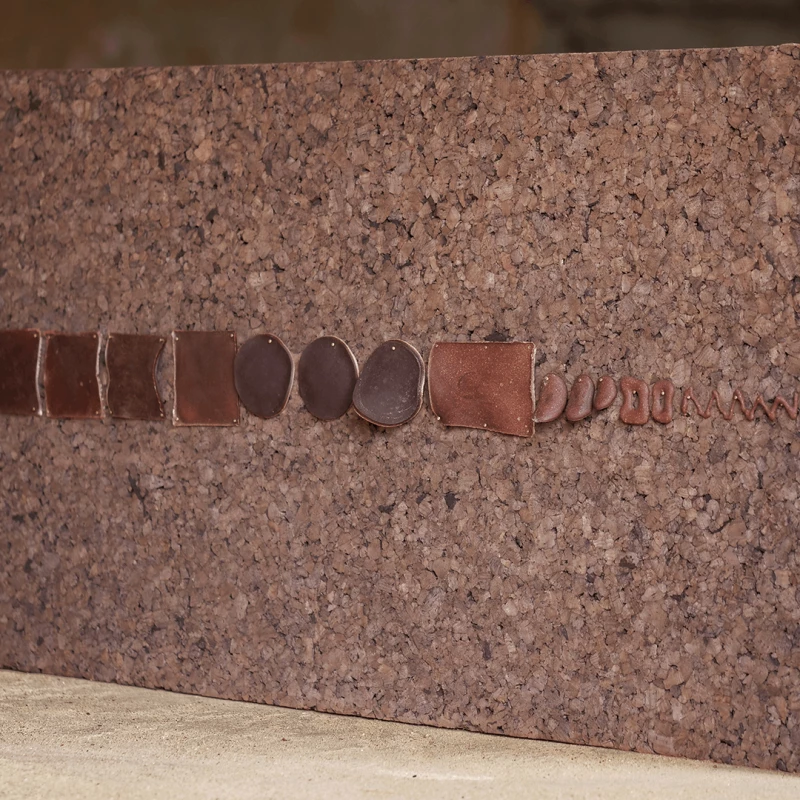
Felipe Shibuya, Tiago Torres-Campos
workshop
Biomaterials from place: exploring local ecologies through bioplastics
This hands-on workshop introduces participants to the development of biomaterials through the making of bioplastics connected to the local landscape. The session begins with a short contextual introduction to Portugal’s ecological conditions, with particular attention to ongoing desertification processes, especially in the southern regions. This framing invites participants to consider how environmental change shapes the availability and meaning of natural resources.
Participants will engage in guided material experimentation using ingredients that hold local significance, such as soils from Alentejo and water from the Tejo, combined with base components commonly used to produce bioplastics. Through mixing, heating, and casting these materials, participants will observe how variations in ingredients influence the physical and visual qualities of the resulting bioplastics.
Rather than focusing solely on producing a finished material sample, the workshop emphasizes the process of decision-making as a form of ecological thinking. Participants will be encouraged to reflect on how choices of materials, proportions, and techniques relate to broader environmental conditions and resource use. By sharing methods and observations in a collaborative setting, the workshop aims to foster dialogue and offer practical and conceptual tools that participants can adapt within their own creative and research practices.
No prior knowledge required. Participants should wear comfortable clothing appropriate for manual activities.
TUTORS
DATE
DURATION
TICKET PRICE
VENUE
About the designers
Felipe Shibuya is a Brazilian ecologist and artist who explores nature’s visual and communicative signals through bioart, biodesign, and microbiological media.
Tiago Torres-Campos is a Portuguese landscape architect who investigates contemporary landscapes and the Anthropocene through design and speculative representation. Both are professors at the Rhode Island School of Design.

Contact us
Gentler Futures Festival is a not-for-profit initiative by BY THE END OF MAY, a research and design studio exploring the roles of manufacturing and crafts in creating a (non-linear), (post-consumerism) and (anti-alienation) economy. If you are into open source design, distributed manufacturing, local making and regenerative materials, get in touch with us.
A project

Co-funded by
Official Partner

Institutional Partners

Academic Partner

International Partners
