Grounds of Care x Studio Method
workshop
Carbon-negative soup: soil regeneration meets cooking
Biochar is one of the oldest and most overlooked climate tools we have. Burn organic matter slowly, without oxygen, and you get a stable form of carbon that can be locked into soil for thousands of years, improving fertility, water retention, and plant growth along the way. Simple in principle, and almost entirely absent from mainstream climate conversation. What makes it worth paying attention to now is partly that simplicity. The process is low-tech, locally adaptable and replicable, which means it can be taken up by communities, urban farms, or individuals working with whatever organic waste is available to them.
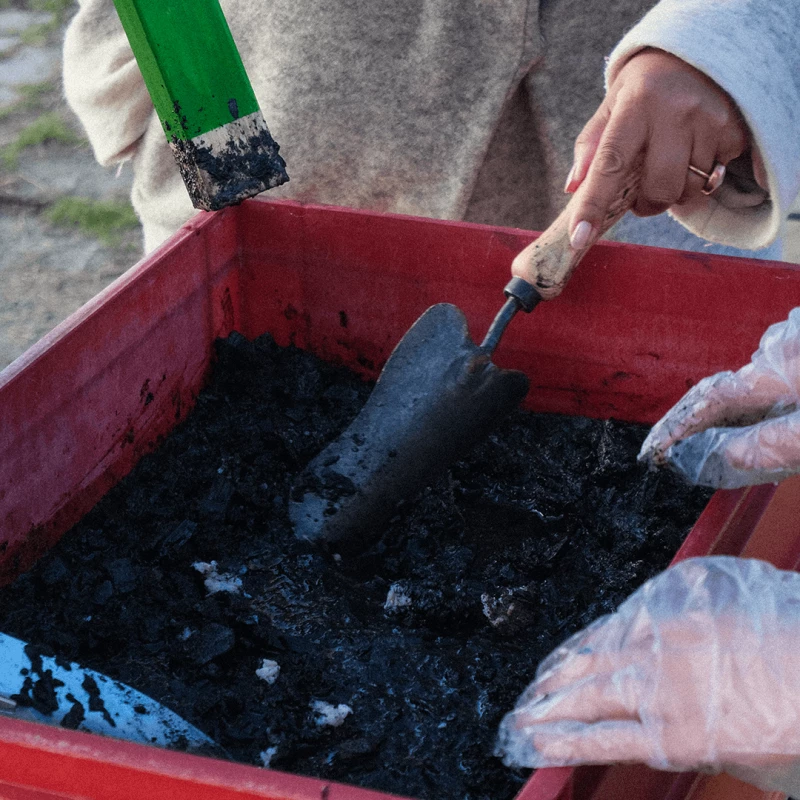
This workshop takes that process as its starting point. Using local waste wood, participants will be invited to run a full production cycle together: raw material goes into a small, oxygen-deprived oven, producing charcoal that can be processed into biochar. The heat generated in the process is used to cook.
Grounds of Care and Studio Method will walk through how these ovens are built, how the kiln process works, and the benefits of biochar for the soil. Participants take part in the full process, from firing to food. Some biochar goes home with you, the rest is donated to a local urban farm.
The session closes with a shared meal and an open conversation about low-tech approaches to soil health, carbon, and what it might look like to build more of this kind of practice into everyday life.
Participants should wear comfortable clothing appropriate for manual activities. Participants should bring a container to bring biochar home.
TUTORS
DATE
DURATION
TICKET PRICE
VENUE
installation
Carbon-negative soup
This installation explores how everyday tools can support regenerative practices. It focuses on biochar, a material produced by slowly burning organic matter in low-oxygen conditions. This process creates a stable form of carbon that can be stored in soil, improving fertility, water retention, and plant growth. Despite its simplicity, biochar remains largely absent from common climate approaches.
The installation approaches biochar not only as a material process, but also as a social one. Heat has long acted as a point of gathering, bringing people together around fire and food. The stove presented here uses the heat generated during biochar production for cooking, opening the possibility for shared use and interaction.
The installation is organised around two elements: tools and soil. It presents different tools for producing biochar and introduces its potential use in soil. Visitors are invited to engage through smell and touch, exploring the material and its relation to soil conditions.
DESIGNERS
DATE
VENUE
About the studios
Grounds of Care is a Netherlands-based research and design practice by Alicia Ville and Crystal Mah that fosters practices of sharing and care for social and ecological regeneration.
Studio Method is a research-driven design and architecture practice led by Riel Bessai and Pedro Pantaleone that rethinks waste and reuse to reshape contemporary material culture.

Contact us
Gentler Futures Festival is a not-for-profit initiative by BY THE END OF MAY, a research and design studio exploring the roles of manufacturing and crafts in creating a (non-linear), (post-consumerism) and (anti-alienation) economy. If you are into open source design, distributed manufacturing, local making and regenerative materials, get in touch with us.
A project

Co-funded by

Official Partner

Institutional Partners


Academic Partner

International Partners
