Joseph Henry Kennedy Jr.
exhibition
Designing Plant Microclimates
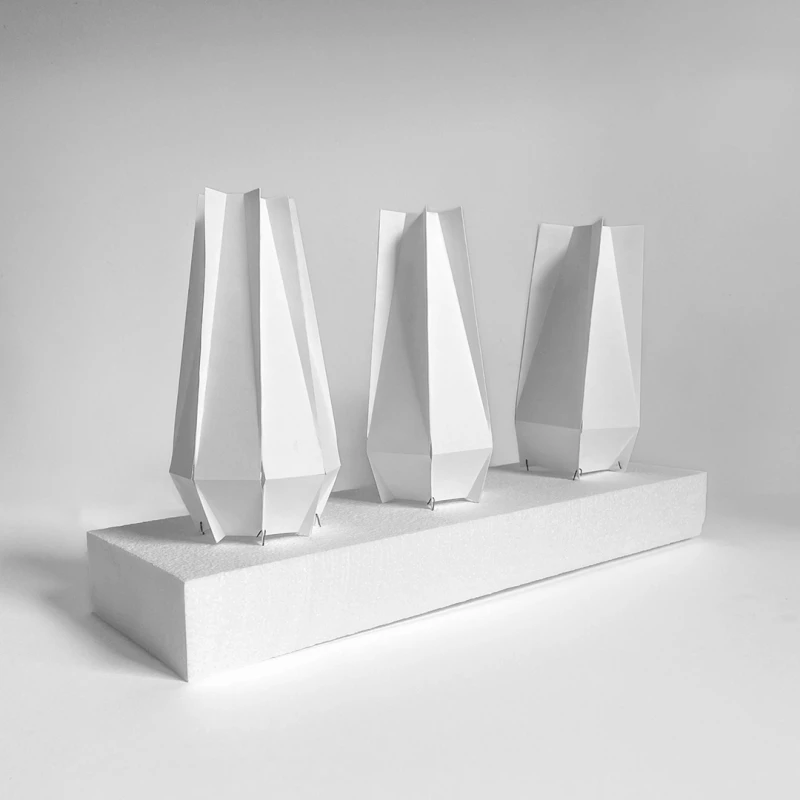
Ecological restoration positions plants differently from farming, gardening, or landscape architecture. Rather than treating vegetation as commodity, ornament, or spatial element for human occupation, restoration frames plants as existing beyond human consumption or aesthetics. Interventions such as tree shelters, guards, and tubes function as low-cost “architectures for plants,” producing controlled microclimates that improve survival in degraded environments.
Designing Plant Microclimates presents a series of physical prototypes alongside a catalog of the design, performance, and financial costs of a set of 150 different commercially available and DIY restoration interventions that simultaneously address microclimatic needs of different plants while attempting to minimize the cost of production, shipping and installation. In parallel, the complex interdependencies between different actors in arid-site ecological restoration have been distilled into an interactive system map intended to show both designers and ecologists which types of restoration interventions can be used to mitigate the distribution, environmental and interaction filters acting on a species pool. These reciprocal relationships between plant species, site, climate and human induced management actions are quantified and calculated in order to visualize the relative performance of a selection of two dozen species under a selection of different treatments in a series of drawings.
DESIGNER
DATES
VENUE
About the designer
Joseph Henry Kennedy Jr. is a Doctor of Design candidate at Harvard GSD whose research combines digital fabrication and applied ecology. He has taught at Berkeley, Woodbury and the BAC, and has worked at Snøhetta, Miniwiz, OPT and NASA JPL. Joe received a M.S. from MIT and a B.Arch from Cornell.


Contact us
Gentler Futures Festival is a not-for-profit initiative by BY THE END OF MAY, a research and design studio exploring the roles of manufacturing and crafts in creating a (non-linear), (post-consumerism) and (anti-alienation) economy. If you are into open source design, distributed manufacturing, local making and regenerative materials, get in touch with us.
A project

Co-funded by

Official Partner

Institutional Partners


Academic Partner

International Partners
