László Cseresznyés x BY THE END OF MAY
installation
Living Layers
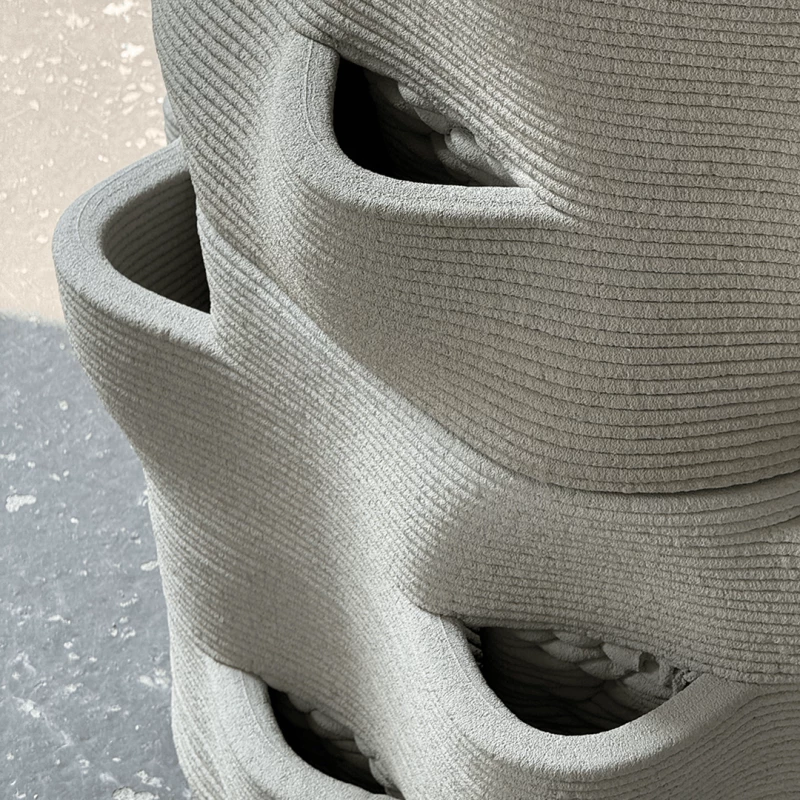
Living Layers is a vertical micro-ecosystem designed to support local food production while hosting biodiversity in urban environments. The project combines ecology, computation, and material research to imagine a different approach to urban farming—one that works with natural processes rather than relying on high-tech controlled systems.
The installation is composed of stacked porous volumes made from clay or concrete and fabricated through additive manufacturing. Their material properties allow them to absorb, store, and distribute water passively through gravity and capillarity, reducing the need for energy-intensive irrigation.
Its geometry is generated through an algorithm informed by biological data. Plants and other ecological actors are treated as active agents, with their spatial needs, sunlight exposure, water requirements, and seasonal cycles translated into design parameters. The resulting surfaces are designed to host not only edible plants, but also mosses, fungi, pollinators, and microorganisms.
Living Layers is a project designed and developed by László Cseresznyés and BY THE END OF MAY, in collaboration with Upfarming, and prototyped by SIR3D / Sirolis.
DESIGNERS
DATES
VENUE
About the designers
László Cseresznyés is an architect, computational designer, and researcher working across design, science, and low-tech construction, with a focus on interspecies intelligence, natural systems, and alternative building methods.
BY THE END OF MAY is a research and design studio exploring the roles of manufacturing and crafts in creating a non-linear, post-consumerism and anti-alienation economy.

Contact us
Gentler Futures Festival is a not-for-profit initiative by BY THE END OF MAY, a research and design studio exploring the roles of manufacturing and crafts in creating a (non-linear), (post-consumerism) and (anti-alienation) economy. If you are into open source design, distributed manufacturing, local making and regenerative materials, get in touch with us.
A project

Co-funded by
Official Partner

Institutional Partners

Academic Partner

International Partners
