Phyta Biodesign
talk
Fauna: abiotic architecture for the biotic world
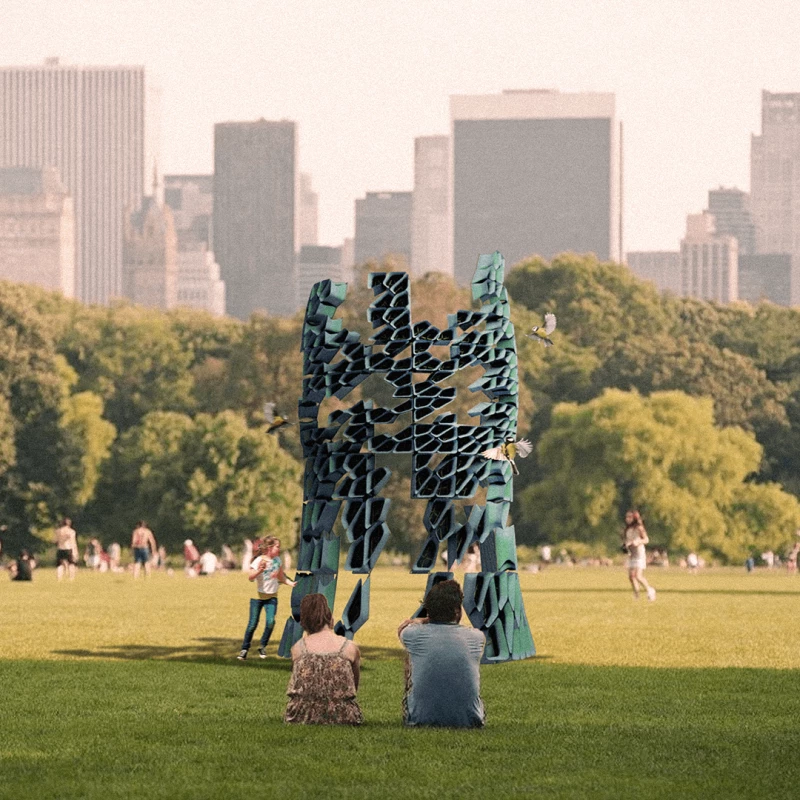
Cities are often built around a human-centred logic, designed primarily for human occupation and largely excluding other forms of life. Materials such as steel, glass, brick, and mortar are typically impervious, limiting the coexistence of other species within the built environment. ‘Fauna’ is a practice-based design research project that asks: what would architecture look like if it were designed for the species it displaces?
‘Fauna’ is a 3D-printed modular habitat system that integrates precision-engineered habitats directly into building surfaces. Each component is generated from site-specific biodiversity data, translating ecological requirements into architectural geometry. Cavity depth, aperture size, surface texture, and material porosity are defined by the nesting behaviours, body morphology, and territorial patterns of target species such as cavity-nesting birds, solitary bees, and urban invertebrates.
The talk presents ‘Fauna’ as a case study exploring how digital fabrication, material research, and ecological knowledge can be combined in a design process. The project draws on ceramic as a structural and bio-receptive material, computational design as a way to translate ecological data, and field installations as a method for testing and iteration. Each installation allows species activity to inform further design development.
SPEAKER
DATE
VENUE
exhibition
Fauna
Fauna challenges the conventional role of building surfaces, transforming them from ecological dead zones into precision-engineered habitats for urban wildlife. Each module is computationally designed using site-specific biodiversity data by translating species decline patterns, foraging behaviours, and microclimate needs directly into architectural form.
The pieces are 3D-printed in clay or wood composites, with surface textures that not only reveal the logic of digital fabrication but actively encourage the natural deposition of algae and moss, initiating a slow process of ecological colonisation. The organic geometries are inspired by patterns found in nature providing nesting cavities tailored to target urban species.
Rather than applying nature to architecture as an afterthought, Fauna embeds ecological intelligence into the fabric of the building itself. Modular and scalable, each installation is uniquely adapted to its local ecosystem, rejecting the one-size-fits-all logic of conventional construction. We explore mass customisation driven by ecological performance, where every surface becomes an active participant in urban regeneration.
SPEAKER
DATE
VENUE
About the studio
Phyta Biodesign is a London-based nature-tech startup developing modular 3D-printed habitat structures, supporting the presence of different species within the built environment. Their work uses site-specific biodiversity data and generative design to integrate habitats directly into building facades, transforming urban surfaces into functioning micro-ecosystems.

Contact us
Gentler Futures Festival is a not-for-profit initiative by BY THE END OF MAY, a research and design studio exploring the roles of manufacturing and crafts in creating a (non-linear), (post-consumerism) and (anti-alienation) economy. If you are into open source design, distributed manufacturing, local making and regenerative materials, get in touch with us.
A project

Co-funded by

Official Partner

Institutional Partners


Academic Partner

International Partners
